
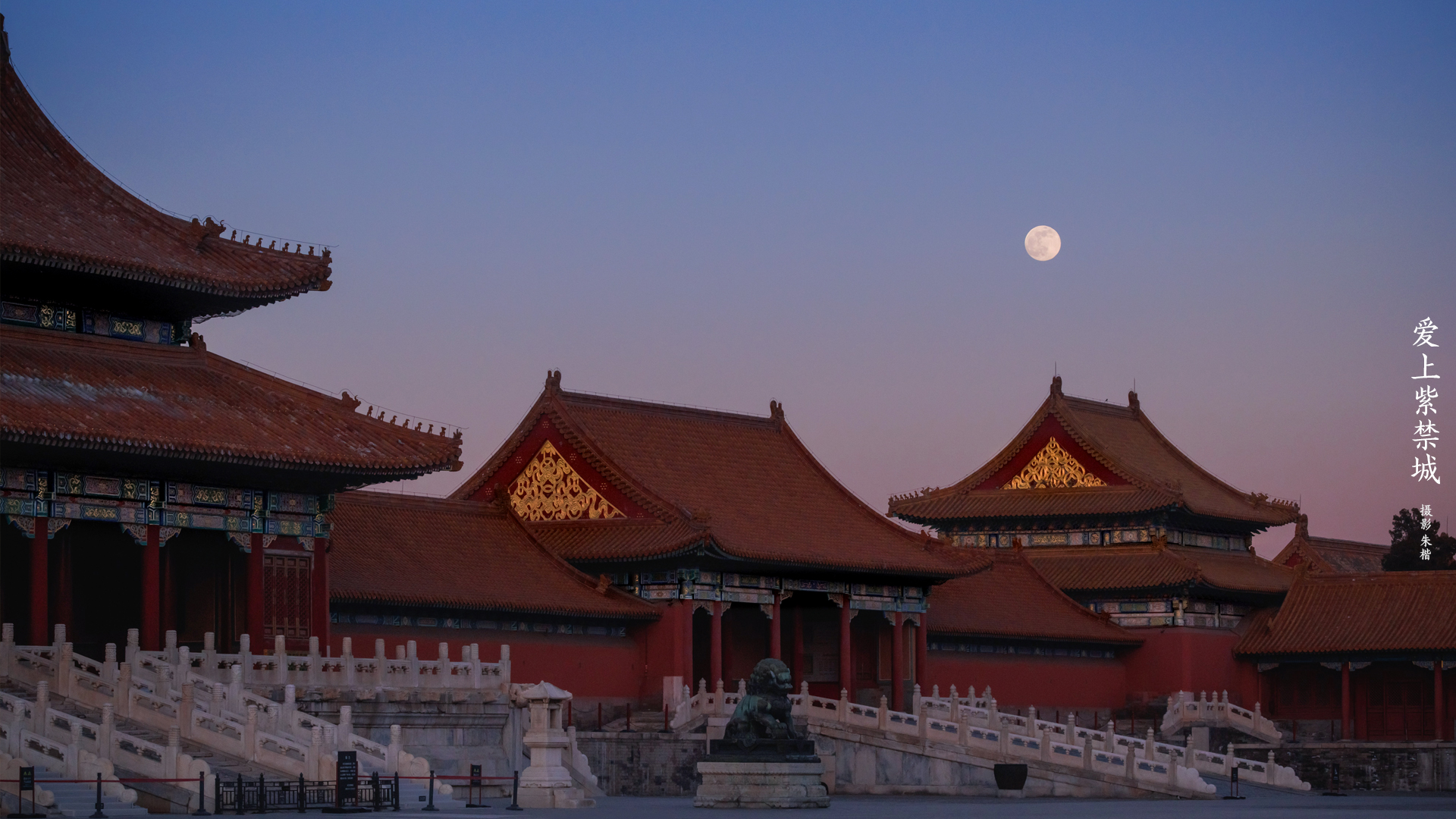
Forbidden city, a palace where 24 emperors resided. This is a legendary building that witnessed the change in time and history, a magical building full of pretty culture and art and a mark of the long history.
History
The young Emperor of the Ming Dynasty, Emperor Le, decided to move the capital from Nanjing to Beijing in 1403. He then decided to create a jaw dropping, amazing and spectecular palace in Beijing, which is now known as the legendary Forbidden City. The construction project took 14 years and required a large number of workers. Additionally, it was made with expensive and rare materials. Finally, in 1420, the construction was completed. The Forbidden City was built and designed based on the principles of feng shui, a Chinese art and philosophy.
However, just 1 years later, a fire broke out in the Forbidden City. The three most important palaces were burned down. The whole palace took 20 years to be reconstructed and rebuilt. In 1557, the palace is struct by a thunder and the fire broke out in the Forbidden City again. This time, the rebuilt took 30 years.
In 1644, the rebel force leaded by Li Zi Cheng gained control in parts of China and the Ming Dynasty ended. He announced the start of the Shun dynasty here. However, this was a short lived empire, which only existed for 2 years. Li Zi Cheng is being defeated by the Manchus and he soon escaped from Beijing. Before he escapes, he set a fire in the Forbidden City (“皇宫太和殿:为何多次遭遇火灾 _奉天”).
The Manchus conquered Beijing and gained control over China. They started to rebuild the Forbidden City. This time, the rebuild took more than 50 years. After the Manchu royals moved in the Forbidden City, many Samanian elements were added to the palace and the name of the different parts of the palace was changed. New buildings like gardens and libraries are also introduced (中华文史网-清史参考).
In 1911, the republic of China established, the Forbidden City was given to the government and the last emperor of China, Puyi abdicated. However, the government still allow Puyi to live in the palace. 14 years later, Puyi was being kicked out of the Forbidden City during the Beijing Coup. After that, the government turned the Forbidden City in to a museum and protected the buildings and artifacts in the palace.
After the establish of the people’s republic of China, the government repaired and restored many buildings that were damaged and promoted the Forbidden City as a part of tourism.
Structure
The Forbidden city is located in the middle of the city. Just like Si He Yuan and other Chinese buildings, the Forbidden City is symmetrical. Many of the palace lies on the north-south central axis. The other palaces are also evenly distributed on this center axis. The buildings are build in a balanced and symmetrical way.
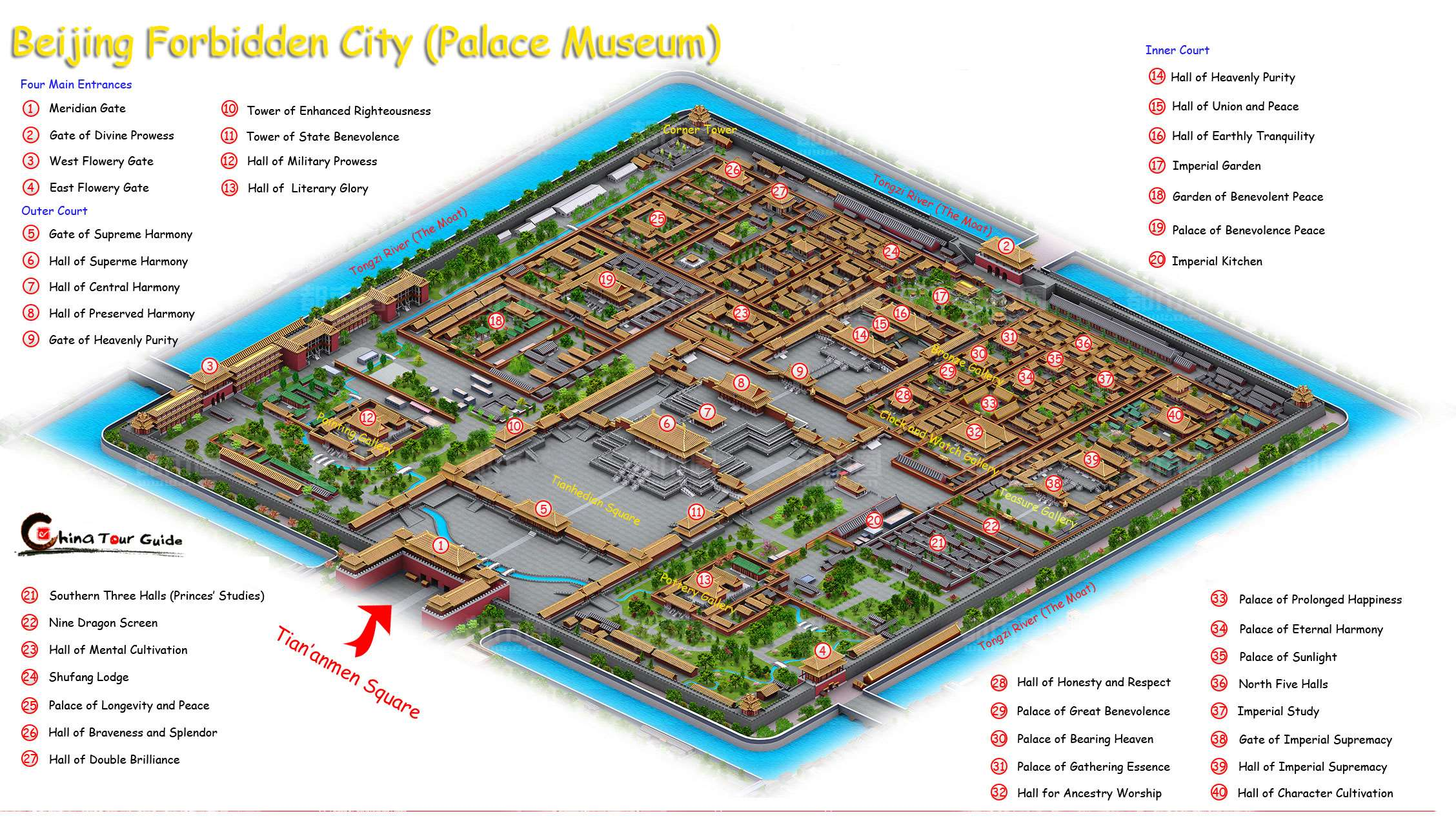
Forbidden City Map, Map of Beijing Palace Museum 2023. www.chinadiscovery.com/china-maps/forbidden-city-map.html.
The Forbidden City is being surrounded by 4 different gates - Meridian Gate (午门), the Gate of Divine Prowess (神武门) on the north, the south and the east gate.
The whole Forbidden City includes two main parts:
- The outer court: This is the part where the emperor works. The palace here is grand and stately, and the courtyard is magnificent and large.
- The inner court: This is the part that people lives. The decoration style here fancy but elegant. The building here are small and pretty.
The Forbidden Palace also follows the rule of feng shui. For example, the inner court is where the Chinese emperor works. This place has the properties of 'yang'; therefore, it is placed in front. The inner court, which has the property of 'yin,' is placed at the back.
Furthermore, the Forbidden City also has many symbols. For example, the roof of the Hall of Supreme Harmony (太和殿) has many different types of animals on its roof, such as lions, dragons, phoenixes, and more. These animals symbolize luck, royalty, power, and other meanings (光明日报).
The Forbidden City also includes many symbols of dragons. The dragon symbols are seen on the roofs, in the paintings, in the sculptures, and in many other details. The inner court itself already has more than 12,654 symbols of dragons in it. One of the reasons is that it symbolizes great power, strength, and control. Another reason is that some emperors and leaders in ancient China thought they were '真龙天子', which means the emperors were the real dragons from the heaven (小烧饼喂先生).
The use of color in the Forbidden City is deeply rooted in feng shui principles. The significance of the color yellow cannot be overlooked, as it represents the essence of all things and signifies the emperor's central role in the world and the lives of the people. that's why the yellow color is being treated as the 'royal color' and used very frequently in the palace.
Besides that, the color green is another color that is used frequently in Forbidden City. The green color represents wood, which symbolizes growth and changes. Lastly, the red color is also used in Forbidden City. Many parts of the Hall of Supreme Harmony (太和殿, which is shown in the model abov) is painted in red. This is because red represents fire, which creates the central earth. Using red color symbolizes the growth and eternity of the empire. Another reason is that the emperor of Ming dynasty have the surname of ‘朱’, which means red in Chinese (嘉林堂).
Conclusion
As conclusion, Forbidden City is not only a building. What makes it truly fascinating is the culture, the philosophy, the art and the history behind it. It is a building that witnessed more than 500 years of history and stands as a remarkable testament to the past
Reference
- Forbidden City Map, Map of Beijing Palace Museum 2023. www.chinadiscovery.com/china-maps/ forbidden-city-map.html.
- www.fractal-technology.com and 故宫博物院. “导览 - 故宫博物院.”
- 故宫博物院, www.dpm.org.cn/Visit.html. 世界文化遗产——故宫.
- www.gov.cn/test/2006-03/28/content_238242.htm.
- 中华文史网-清史参考. www.qinghistory.cn/qsck/431153.shtml.
- 光明日报. “故宫太和殿的建筑细节与文化之美.” 新浪移动_手机新浪网, 7 Aug. 2021, finance.sina.cn/tech/2021-08-07/detail-ikqcfncc1406209.d.html?fromtech=1.
- 嘉林堂. 故宫风水——古代高人到底有多厉害. 27 Mar. 2020, ishare.ifeng.com/c/s/7vBOGASupbM.
- 小烧饼喂先生. “故宫里真藏了上千万龙吗?为什么故宫里有那么多龙?!” 新浪网, 18 Mar. 2019, k.sina.cn/article_6644933884_18c11a4fc00100fl5p.html.
- “探秘故宫建筑里隐藏的风水文化_午门.” Copyright © 2017 Sohu.com Inc. All Rights Reserved., www.sohu.com/a/310756553_717847.
- 王其钧著. 雨中春树人家:品味华夏古建筑. BEIJING BOOK CO. INC., 2017.
- “皇宫太和殿:为何多次遭遇火灾 _奉天.” Copyright © 2017 Sohu.com Inc. All Rights Reserved., www.sohu.com/a/283157535_120031269.
